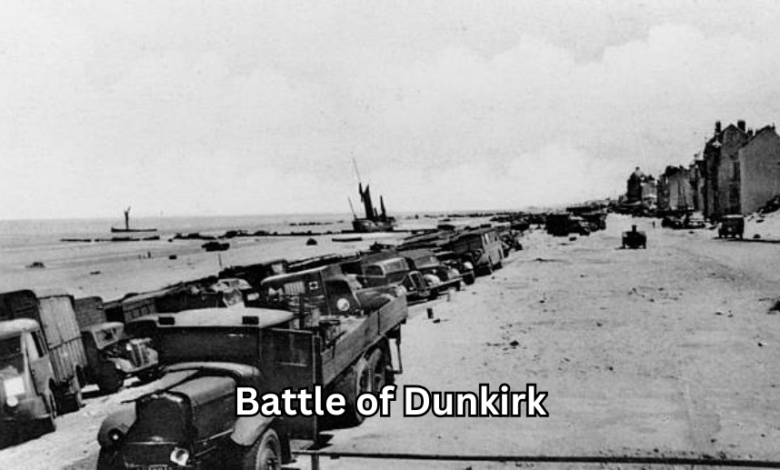
The Battle of Dunkirk is one of the most talked-about moments of World War II because it was both a disaster and a rescue story. On paper, the Allies were trapped. German forces had pushed through Western Europe with frightening speed, British and French troops were surrounded near the coast, and the English Channel was their only possible escape route.
But what happened at Dunkirk was not a simple battlefield victory. It was a desperate military withdrawal, a defensive stand, and a massive evacuation known as Operation Dynamo. More than 338,000 Allied soldiers were rescued from Dunkirk between late May and early June 1940, even though Britain initially expected to save far fewer men.
This guide explains when the Battle of Dunkirk happened, where it took place, who won the Battle of Dunkirk, what the map looked like, how many people died, and why Dunkirk still matters today.
Battle of Dunkirk Summary
The Battle of Dunkirk WW2 took place during the larger Battle of France in 1940. Germany had invaded Belgium, the Netherlands, Luxembourg, and France in May 1940. Using fast-moving armored forces and air support, German troops broke through Allied defenses and pushed toward the English Channel.
This left hundreds of thousands of British, French, and Belgian troops trapped around Dunkirk, a port town in northern France. The Allies had their backs to the sea, while German forces closed in from land and the Luftwaffe attacked from the air.
The main Allied goal became survival. Instead of trying to defeat Germany at Dunkirk, the British and French tried to hold a defensive perimeter long enough to evacuate as many soldiers as possible. This evacuation was called Operation Dynamo.
The result was dramatic: the Allies lost the battle on land, but the evacuation saved a large part of the British Army and many French troops. That allowed Britain to keep fighting after France fell.
When Was the Battle of Dunkirk?
The Battle of Dunkirk date is usually given as 26 May to 4 June 1940, matching the main evacuation period of Operation Dynamo. Some fighting around the Dunkirk perimeter began as the Allied armies retreated toward the coast, but the most famous phase was the evacuation from the beaches and harbor.
A simple timeline looks like this:
- 10 May 1940 — Germany invaded France and the Low Countries.
- Late May 1940 — Allied forces were pushed back toward Dunkirk.
- 26 May 1940 — Operation Dynamo began.
- 27 May–4 June 1940 — Most of the evacuation took place.
- 4 June 1940 — The operation ended, and Germany captured Dunkirk soon after.
So, if someone asks, “When was the Battle of Dunkirk?” the clearest answer is: it happened mainly from 26 May to 4 June 1940, during World War II.
Where Was the Battle of Dunkirk?
The Battle of Dunkirk location was around Dunkirk, a port city in northern France, close to the Belgian border and facing the English Channel.
If you look at the Battle of Dunkirk on map, the location becomes easier to understand. Dunkirk sits on the coast of northern France, across the Channel from southeastern England. That geography mattered because the trapped Allied soldiers could not retreat south or east. Their only realistic escape route was by sea.
So, when people ask, “Where did the Battle of Dunkirk take place?” the answer is:
The Battle of Dunkirk took place around the town, beaches, harbor, and defensive perimeter of Dunkirk in northern France, with evacuation routes running across the English Channel to Britain.
Battle of Dunkirk Map Explained
A Battle of Dunkirk map usually shows three important things:
- German forces advancing from the east and south
- Allied troops trapped near the northern French coast
- Evacuation routes crossing the English Channel toward Britain
The map is important because Dunkirk was not a normal battle where two armies met in a clear open field. It was more like a shrinking pocket. Allied troops were compressed into a coastal area while German forces pressed closer.
The beaches were wide and shallow, which created a major problem. Large Royal Navy ships could not always come directly to shore. That is why smaller civilian boats, fishing vessels, lifeboats, and pleasure craft became important for moving soldiers from shallow water to larger ships offshore. IWM notes that more than 800 boats helped facilitate the evacuation.
A useful way to picture the Battle of Dunkirk WW2 map is this:
Dunkirk was the exit door, the sea was the escape corridor, and the Allied defensive perimeter was the temporary wall holding German forces back.
What Was Operation Dynamo?
Battle of Dunkirk Operation Dynamo refers to the evacuation plan organized by the Royal Navy to rescue Allied soldiers from Dunkirk. The operation was directed from tunnels beneath Dover Castle in England.
Operation Dynamo began on 26 May 1940. Its goal was simple but extremely difficult: get as many soldiers as possible out of Dunkirk before German forces captured the area.
The evacuation used:
- Royal Navy destroyers
- Merchant ships
- Ferries
- Fishing boats
- Lifeboats
- Pleasure craft
- Other small civilian vessels
One unique insight often missed is that the “little ships” were important, but they were not the whole story. A large number of men were evacuated from Dunkirk’s harbor and eastern mole, not only directly from the beaches. The popular memory often focuses on small boats, but the harbor infrastructure also played a huge role in saving lives.
Why Was Dunkirk So Important?
Dunkirk mattered because Britain could not afford to lose its trained army in 1940. If the British Expeditionary Force had been captured, Britain would have faced the next phase of the war with far fewer experienced soldiers.
The evacuation did not win the war. In fact, Winston Churchill warned that “wars are not won by evacuations.” But Dunkirk gave Britain something priceless: time, morale, and manpower.
The rescue also changed the emotional mood in Britain. A military retreat became a symbol of determination. The phrase “Dunkirk spirit” later came to mean courage, endurance, and unity under pressure.
But there is another side that should not be ignored. Dunkirk was also a defeat. The Allies abandoned huge amounts of equipment, including vehicles, artillery, and supplies. The men were saved, but much of the army’s heavy equipment was left behind.
Who Won the Battle of Dunkirk?
The question “Who won the Battle of Dunkirk?” has two answers, depending on how you define winning.
Militarily, Germany won the land battle. German forces captured Dunkirk and defeated the Allied position in northern France.
Strategically, however, the Allies achieved a vital success by evacuating more than 338,000 soldiers. That meant Britain could continue the war instead of losing a large part of its army.
So the best answer is:
Germany won the battlefield, but the Allies won a crucial evacuation victory by saving hundreds of thousands of troops.
This is why Dunkirk is remembered as both a defeat and a miracle.
Battle of Dunkirk Casualties
The Battle of Dunkirk casualties are difficult to summarize with one number because the fighting was part of the larger Battle of France. Different sources count killed, wounded, captured, missing, and lost equipment in different ways.
A commonly cited figure is that more than 338,000 Allied troops were evacuated, while many others were killed, wounded, or captured during the wider campaign and retreat. The Guardian, covering Dunkirk’s 75th anniversary, reported that about 90,000 people died, were wounded, or were taken prisoner in connection with the evacuation and surrounding events.
If the question is “How many people died in the Battle of Dunkirk?”, the answer should be careful: exact death totals vary by source and definition. Some counts focus only on Dunkirk itself, while others include the broader retreat through France and Belgium.
What is clear is that the evacuation saved hundreds of thousands of lives, but it did not happen without major losses.
Why Did Germany Not Destroy the Allied Army at Dunkirk?
One of the biggest questions about Dunkirk is why German forces did not fully crush the trapped Allied army before the evacuation succeeded.
A common explanation is the German “halt order,” which paused panzer forces for a critical period. IWM notes that a halt command was in place from 28 to 31 May, while heavy air attacks continued against the trapped troops.
But it is too simple to say the halt order alone caused the evacuation’s success. Other factors mattered too:
- German armored units were tired after fast advances.
- The terrain near Dunkirk was not ideal for tanks.
- The Luftwaffe could not fully stop the evacuation.
- Allied troops fought hard to defend the perimeter.
- French forces played a major role in delaying the German advance.
That last point is often underplayed. Dunkirk is sometimes told as a mainly British story, but French troops helped hold defensive lines and bought precious time for the evacuation. Without those rearguard actions, far fewer men may have escaped.
Battle of Dunkirk 1940 and the Role of the French
The Battle of Dunkirk 1940 was not only a British evacuation story. French soldiers were deeply involved in the fighting, the defense, and the evacuation.
IWM notes that around a third of the rescued soldiers were French. This matters because popular memory sometimes makes Dunkirk sound like a British-only event. In reality, it was an Allied operation involving British, French, Belgian, and other forces.
French units also helped defend the perimeter while evacuation continued. Many French soldiers were evacuated, but others stayed behind, fought, or were captured.
A more accurate way to understand Dunkirk is this: Britain escaped disaster because Allied soldiers, including many French troops, held the line long enough for the evacuation to work.
Battle of Dunkirk Movie vs Real History
Many people search for the Battle of Dunkirk movie because Christopher Nolan’s Dunkirk brought the story back into mainstream attention. The film captures the fear, confusion, and tension of the evacuation, but it is not a complete history lesson.
The real Dunkirk story includes wider military context: the German invasion of France, the collapse of Allied defenses, the role of French rearguards, the harbor evacuation, the Royal Navy, civilian boats, RAF air cover, and political consequences in Britain.
The movie is useful for feeling the pressure of the event. But to understand the actual battle, you need the broader WW2 context.
Common Mistakes About the Battle of Dunkirk
Thinking Dunkirk Was a Clear Allied Victory
Dunkirk was not a normal victory. The Allies were forced to retreat, and Germany captured the area. The success was the evacuation, not the land battle.
Ignoring French and Belgian Forces
The story is often told from a British viewpoint, but French and Belgian troops were also involved. French soldiers especially played a major role in holding back German forces.
Believing Only Small Boats Saved the Army
The little ships were important and symbolic, but many soldiers were also evacuated through the harbor and by larger naval vessels.
Forgetting the Equipment Losses
The rescued troops survived, but Britain left behind huge quantities of military equipment. This made Britain’s defense situation more difficult after Dunkirk.
Treating the Halt Order as the Only Reason
The German pause helped, but it was not the only reason the evacuation succeeded. Weather, terrain, air defense, naval organization, and Allied resistance all mattered.
FAQ
When was the Battle of Dunkirk?
The Battle of Dunkirk happened mainly from 26 May to 4 June 1940. This was the period of Operation Dynamo, the evacuation of Allied troops from Dunkirk. The battle took place during the larger Battle of France in World War II.
Where was the Battle of Dunkirk located?
The Battle of Dunkirk took place around Dunkirk, a coastal city in northern France near the Belgian border. The evacuation routes crossed the English Channel from Dunkirk to Britain. On a map, Dunkirk appears as a narrow escape point between advancing German forces and the sea.
Who won the Battle of Dunkirk?
Germany won the land battle because it captured Dunkirk and forced the Allies to retreat. However, the Allies achieved a major strategic success by evacuating more than 338,000 soldiers. That is why Dunkirk is remembered as both a defeat and a rescue miracle.
What was Operation Dynamo in the Battle of Dunkirk?
Operation Dynamo was the code name for the Allied evacuation from Dunkirk. It was organized mainly by the Royal Navy and used military ships as well as civilian vessels. Its purpose was to rescue trapped Allied soldiers before German forces captured the area.
How many people died in the Battle of Dunkirk?
There is no single universally agreed death total because casualty figures vary depending on whether sources count only Dunkirk or the wider retreat in France and Belgium. Many soldiers were killed, wounded, captured, or went missing. What is clear is that more than 338,000 troops were evacuated, while many others did not escape.
Why is the Battle of Dunkirk important in WW2?
The Battle of Dunkirk is important because it saved a large part of the British Army and many French soldiers. Without the evacuation, Britain may have struggled to continue the war. Dunkirk also became a powerful symbol of resilience, even though it came after a serious military defeat.
Conclusion
The Battle of Dunkirk was one of the most dramatic events of World War II. It took place in northern France from late May to early June 1940, when Allied troops were trapped by the German advance and forced toward the sea.
Germany won the land battle, but Operation Dynamo rescued more than 338,000 Allied soldiers and gave Britain the manpower and morale to continue fighting. That is why Dunkirk is remembered in two ways: as a military defeat and as an extraordinary evacuation.
To understand Dunkirk properly, you have to hold both truths together. It was not a clean victory, and it was not just a retreat. It was a desperate escape that changed the course of the war by keeping Britain in the fight.