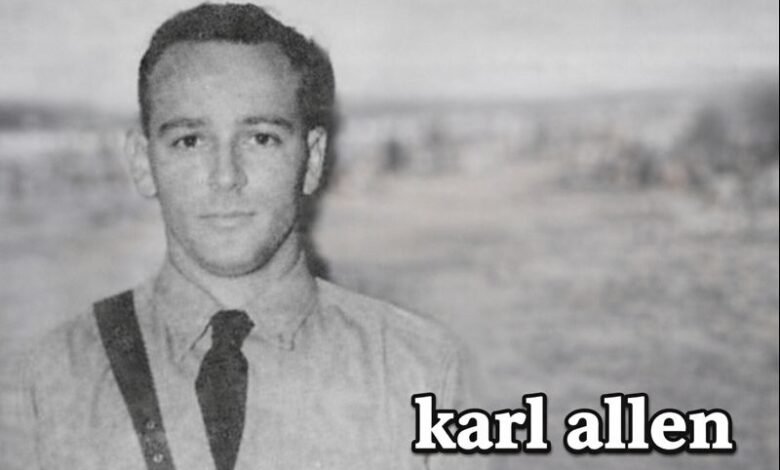
Karl Rogers Allen Jr. (April 23, 1931 – March 5, 2015) was a name tied to some of the most extreme segments of American far-right history. From his early years as a promising young professional to his radical shift into neo-Nazi ideology, Allen’s life encapsulated the rise of white nationalism in post-war America. His involvement in the American Nazi Party (ANP) and later the creation of the White Party of America marked him as one of the more controversial and influential figures within the neo-Nazi movement. This article explores his early life, ideological evolution, leadership in hate-based political movements, and his later years, offering a deeper understanding of his enduring impact on American extremism.
Early Life and Education
Born in Tallahassee, Florida, on April 23, 1931, Karl Allen was the son of Carl and Cody Harris Allen. Raised during the height of World War II, he grew up in a country still grappling with the aftermath of global conflict and the rise of fascist ideologies abroad. While not immediately drawn to radical views in his youth, Allen’s early years were marked by an interest in political theory and history.
Allen attended Florida State University, where he pursued a degree in political science. His academic journey was further enriched by a Master’s in Business Administration from Harvard Business School, reflecting his initial ambitions in the world of finance and development. After his studies, he worked as an industrial specialist, contributing to the state’s economic growth, even playing a role in Florida’s push to attract Disney to the area. His early professional career was far removed from the far-right extremism he would later embrace, showing that his radical shift was not part of a straightforward political evolution.
Radicalization and Entry into Neo-Nazism
In the early 1960s, Allen experienced a dramatic ideological transformation. His political journey shifted when he attended a speech by a right-wing speaker, which left a lasting impression. According to Allen, this speaker’s rhetoric “made sense” to him and acted as a catalyst for his deepening interest in Nazi ideology. Over time, this new worldview led him to the American Nazi Party, a group that had been making headlines for its inflammatory campaigns and provocative demonstrations.
In 1961, Allen’s life took a sharp turn when he left his position in Florida’s nuclear energy program and moved to Arlington, Virginia, to join the ANP. His sudden disappearance alarmed his family, but when he resurfaced months later, it was as a committed member of the party. His new political affiliations shocked those who knew him, as he had previously been seen as a more liberal individual, far from the ideals of white supremacy and hate that he would soon adopt.
Allen’s initial entry into the ANP was met with skepticism, with some members doubting his authenticity. However, his education and professional experience quickly earned him respect, allowing him to rise through the ranks. By 1962, he was serving as the party’s second-in-command, working closely with its leader, George Lincoln Rockwell. His rise to power within the party exemplified the ANP’s focus on organizational structure, which Allen advocated for in contrast to Rockwell’s more chaotic and personality-driven leadership.
Leadership in the American Nazi Party and Split with Rockwell
As a high-ranking member of the American Nazi Party, Allen took on a variety of roles, including organizing protests, writing for the party’s publications, and helping to lead anti-civil rights demonstrations. One of his more notorious moments came in 1963 when he was arrested for giving a speech at a counter-demonstration against the March on Washington.
Despite his rise within the ANP, Allen’s relationship with Rockwell became increasingly strained. While Allen appreciated some aspects of Rockwell’s leadership, he grew frustrated with the party’s disorganization and Rockwell’s handling of its finances and public relations. In December 1963, after a personal dispute with Rockwell, Allen left the ANP and formed the White Party of America, a more nationally focused organization that he hoped would be more sustainable and less reliant on extreme public stunts.
Though the White Party of America occasionally had more members than the ANP, it failed to gain significant media attention. Its core message, however, was one of radical racial separatism, with Allen advocating for the deportation of African Americans and the establishment of a white-dominated society. His vision for the White Party was one that aligned with his growing white nationalist sentiments but lacked the international ambitions of the ANP, reflecting a shift in his political thinking toward more pragmatic, though still extremist, goals.
Later Years and Criticisms
In the years following his departure from the White Party, Allen lived a quieter life, though he continued to maintain strong affiliations with white nationalist movements. He moved to Washington, D.C., and later Tallahassee, Florida, where he ran various bookstores, including the Black Cat News Exchange. His later life was marked by a retreat from the public spotlight, but he remained active in far-right circles and continued to espouse his racially charged views.
In the 1990s, Allen gave interviews to authors exploring the history of the American Nazi Party and reflected on his time within the movement. His critiques of other neo-Nazi figures, including the party’s leader after Rockwell’s assassination, Matt Koehl, highlighted the factionalism that plagued the movement in the post-Rockwell era. Allen, who had once been seen as a potential successor to Rockwell, became disillusioned with the state of the neo-Nazi movement in America, feeling that it had become too fragmented and disconnected from its original goals.
Conclusion
Karl Rogers Allen Jr.’s life was a testimony to the power of ideological transformation and the allure of extremist ideologies during a turbulent period in American history. From a promising young professional to a leader of one of the most infamous neo-Nazi groups in the country, his journey highlights the dangers of radicalization and the enduring appeal of hate-based movements.
While Allen’s influence waned over the years, his story serves as a reminder of the toxic legacies of white supremacy and far-right extremism. At Techmetra, we continue to examine the lives of controversial figures like Allen to better understand the forces that shape political movements and the impact they have on society.
FAQs
1. Who was Karl Rogers Allen Jr.?
Karl Rogers Allen Jr. was a prominent neo-Nazi leader who served as the deputy commander of the American Nazi Party and later founded the White Party of America. He was known for his extremist views on race and his role in far-right movements.
2. What was the White Party of America?
The White Party of America was a neo-Nazi group founded by Allen in 1963 after his split from the American Nazi Party. It advocated for white nationalism and racial segregation, but it failed to gain significant media attention.
3. What led Karl Allen to join the American Nazi Party?
Allen was radicalized by right-wing rhetoric and found himself drawn to Nazi ideology, which he saw as aligning with his beliefs. This led him to join the ANP in 1961, where he quickly rose to a leadership position.
4. How did Allen’s views evolve after leaving the ANP?
After leaving the ANP, Allen founded the White Party of America, which focused more on nationalism and white separatism rather than international neo-Nazi goals. However, he remained committed to racist and exclusionary ideologies throughout his life.
5. What did Karl Allen do after leaving the neo-Nazi movement?
Allen retreated from the public eye and managed bookstores and hotels in Washington, D.C., and Tallahassee, Florida. He continued to promote his extremist views but lived a quieter life in his later years.