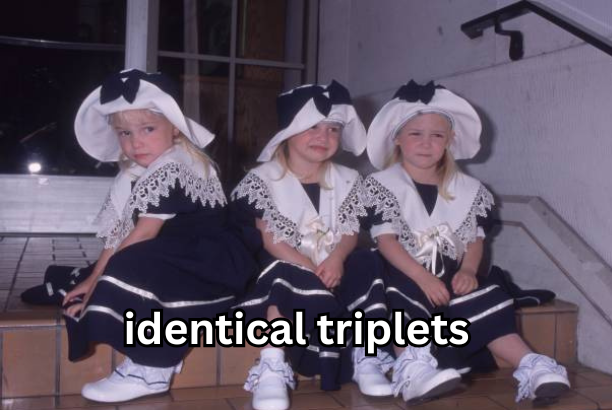
What Are Identical Triplets?
Identical triplets are three babies who develop from a single fertilized egg instead of three separate eggs. Because they originate from one egg and one sperm, all three babies inherit nearly identical genetic material.
Unlike fraternal triplets, who may look quite different from one another, identical triplets often share remarkably similar facial features, eye color, hair texture, and blood type.
Doctors classify triplets into three main groups:
- Identical triplets
- Fraternal triplets
- Mixed triplets (where two are identical and one is fraternal)
Among these, identical triplets are by far the rarest.
Can You Have Identical Triplets?
Yes, can you have identical triplets is a question with a clear scientific answer: absolutely.
The process begins when a single fertilized egg divides into two embryos. Then, one of those embryos divides once more, creating three genetically identical embryos.
Scientists still don’t fully understand why this happens. Unlike fraternal multiples, which are influenced by genetics and maternal age, the splitting of one embryo appears to occur randomly.
This randomness is one reason why identical triplets remain so exceptionally rare.
Are There Identical Triplets?
Many people ask, are there identical triplets, because they’ve never personally met any.
Yes, there are documented cases around the world. Hospitals, universities, and medical journals have reported numerous confirmed cases over the years. However, compared with millions of births annually, the number remains extremely small.
Some identical triplets become well known through documentaries, television interviews, or medical studies because researchers have a unique opportunity to study genetics, development, and environmental influences.
Are Identical Triplets Possible?
Another common question is are identical triplets possible if identical twins themselves are already uncommon.
The answer is yes, although the biological process is extraordinarily unusual.
For identical triplets to develop naturally:
- One sperm fertilizes one egg.
- The embryo splits.
- One resulting embryo splits again.
- Three healthy embryos continue developing.
Each successful step becomes increasingly unlikely, making the overall event exceptionally rare.
Can There Be Identical Triplets Naturally?
Yes, can there be identical triplets without fertility treatments?
Absolutely.
While fertility medications can increase the likelihood of triplets in general, they primarily raise the chances of releasing multiple eggs. They do not directly cause one embryo to split into three identical babies.
Medical experts believe identical triplets usually occur as a spontaneous event rather than something that can be predicted or intentionally produced.
Is It Possible to Have Identical Triplets?
Many expecting parents wonder, is it possible to have identical triplets without any family history.
Unlike fraternal twins or triplets, which may run in families through the mother’s side, identical triplets are not believed to have a strong inherited pattern.
This means:
- Family history usually doesn’t matter.
- Maternal age has little influence.
- Lifestyle choices don’t appear to increase the odds.
- The event seems largely random.
That unpredictability makes every confirmed case fascinating to obstetricians and genetic researchers alike.
How Rare Are Identical Triplets?
One of the biggest questions people ask is how rare are identical triplets.
Experts estimate naturally occurring identical triplets happen in roughly one out of every 100 million births, although estimates vary because so few cases exist.
Several factors contribute to this rarity:
- A single embryo must split twice.
- All three embryos must survive.
- The pregnancy must continue successfully.
- The babies must develop without severe complications.
Even specialists in maternal-fetal medicine may never personally care for an identical triplet pregnancy during their entire careers.
A Unique Insight Most People Never Hear
One interesting fact rarely discussed is that not every set of identical triplets remains completely genetically identical throughout life.
Shortly after conception, tiny spontaneous DNA mutations can occur as cells continue dividing. These changes are extremely small but mean that, over time, each sibling may develop subtle genetic differences that scientists can detect using advanced sequencing technology.
Although they are still considered identical siblings, their DNA is not always 100% perfectly matched by adulthood.
Odds of Identical Triplets
The odds of identical triplets are difficult to calculate precisely because confirmed cases are so uncommon.
Medical estimates generally place the chance somewhere between:
- 1 in 60 million births
- 1 in 100 million births
- Even lower according to some researchers
For comparison:
- Identical twins occur in roughly 3–4 births per 1,000.
- Triplets are much less common.
- Naturally conceived identical triplets are extraordinarily rare.
These statistics explain why identical triplets frequently make international headlines whenever they are born.
Identical Triplets Ultrasound
An identical triplets ultrasound is one of the earliest ways doctors detect this remarkable pregnancy.
Modern ultrasound technology allows specialists to identify:
- The number of babies
- Shared placentas
- Shared amniotic sacs
- Fetal growth patterns
- Heartbeats
- Early pregnancy complications
Because identical triplets may share a placenta, doctors often schedule more frequent scans than they would for a singleton pregnancy.
Regular monitoring helps detect conditions such as unequal blood flow or growth differences before they become serious.
Another Rarely Mentioned Insight
Many parents assume the biggest challenge is simply carrying three babies. In reality, one of the greatest medical concerns is ensuring each baby receives an equal share of nutrients and blood supply when they share a placenta.
This delicate balance is monitored throughout pregnancy using repeated ultrasounds, Doppler imaging, and fetal growth measurements, allowing specialists to intervene early if needed.
Three Identical Triplets: How Do They Compare With Other Multiple Births?
The phrase three identical triplets simply refers to three siblings who all developed from the same fertilized egg. Although they share nearly identical DNA, they are still unique individuals with their own personalities, interests, and life experiences.
Here’s how identical triplets compare with other types of multiple births:
| Type | Fertilized Eggs | DNA Similarity |
|---|---|---|
| Identical Twins | One | Nearly identical |
| Fraternal Twins | Two | Similar to regular siblings |
| Identical Triplets | One | Nearly identical among all three |
| Fraternal Triplets | Three | Similar to regular siblings |
Even when identical triplets look almost exactly alike, parents often notice subtle differences early on, such as facial expressions, voice, sleeping habits, or temperament.
How Many Identical Triplets Are There in the World?
People often ask, how many identical triplets are there in the world. Unfortunately, there is no official worldwide registry that tracks every case.
However, medical researchers believe only a relatively small number of confirmed sets have been documented throughout modern history. Since many births occur in different countries without centralized reporting, the exact number remains unknown.
Despite the lack of precise records, identical triplets remain one of the rarest naturally occurring human birth events.
Famous Identical Triplets
Several famous identical triplets have attracted public attention because of their extraordinary resemblance and inspiring stories.
Some became well known through television documentaries, while others gained recognition in entertainment, education, sports, or scientific research.
Their stories often demonstrate that although genetics play an important role in appearance, environment and personal experiences shape each sibling into a unique individual.
Researchers have also studied famous identical triplets to better understand:
- The influence of genetics on personality.
- How environment affects development.
- Differences in health despite nearly identical DNA.
- Learning styles and behavior over time.
These studies continue to improve our understanding of human biology.
Identical Triplets Separated at Birth
Stories about identical triplets separated at birth naturally capture public interest because they provide rare opportunities to study nature versus nurture.
When identical siblings grow up in different environments, researchers can compare:
- Personality development.
- Educational achievement.
- Career interests.
- Health conditions.
- Behavioral differences.
One unique insight from these studies is that while identical genetics strongly influence certain physical traits, life experiences often have a much greater impact on values, confidence, communication skills, and career choices than many people expect.
This reminds us that genes provide the blueprint, but environment helps shape the final outcome.
CSUCI Identical Triplets Graduation
One story that gained widespread attention involved the CSUCI identical triplets graduation, where three identical sisters celebrated earning their degrees together at California State University Channel Islands.
Their graduation became popular because it highlighted not only their striking resemblance but also their shared dedication to education and personal achievement.
The event inspired many people and demonstrated that although identical siblings often follow similar paths, each still develops individual goals and ambitions.
Challenges of an Identical Triplet Pregnancy
Pregnancy with identical triplets requires close medical supervision because it carries higher risks than a singleton pregnancy.
Doctors carefully monitor:
- Premature labor.
- Low birth weight.
- Placental complications.
- Blood flow between babies.
- Maternal health.
- Fetal growth.
Most mothers receive more frequent prenatal appointments and ultrasounds than in a typical pregnancy.
Early monitoring allows healthcare providers to detect complications quickly and improve outcomes for both mother and babies.
Common Myths About Identical Triplets
Many misconceptions surround identical triplets. Let’s separate fact from fiction.
Myth: They are always impossible.
Fact: They are extremely rare but medically documented.
Myth: They always look exactly the same.
Fact: Small physical differences often develop as they grow.
Myth: They share identical personalities.
Fact: Personality is influenced by both genetics and life experiences.
Myth: Fertility treatments always create identical triplets.
Fact: Fertility treatments mainly increase fraternal multiple pregnancies, not embryo splitting.
Myth: Doctors can predict identical triplets before conception.
Fact: There is currently no reliable way to predict or prevent natural embryo splitting.
Frequently Asked Questions
Can identical triplets have different fingerprints?
Yes. Although their DNA is nearly identical, fingerprints develop in the womb through tiny environmental influences such as pressure, movement, and amniotic fluid. This is why fingerprints remain unique even among identical siblings.
Do identical triplets always share one placenta?
Not always. Depending on when the embryo splits, identical triplets may share one placenta, two placentas, or have different arrangements. Doctors determine this through early pregnancy ultrasounds.
Can DNA tests tell identical triplets apart?
Standard DNA tests often show them as nearly identical. However, advanced genetic sequencing can detect tiny mutations that develop after conception, allowing scientists to distinguish between them.
Why are identical triplets considered so rare?
The embryo must split twice at exactly the right stages while all three embryos continue developing successfully. Each step is uncommon, making the overall event exceptionally rare.
Are identical triplets healthier than fraternal triplets?
Neither type is automatically healthier. Health outcomes depend on pregnancy conditions, prenatal care, gestational age at birth, and many other medical factors rather than whether the babies are genetically identical.
Conclusion
Identical triplets represent one of the rarest and most fascinating events in human biology. While many people ask, can you have identical triplets, the answer is a definite yes—although the odds are incredibly small. Advances in prenatal care and ultrasound technology have greatly improved doctors’ ability to monitor these high-risk pregnancies and support healthy outcomes.
Perhaps the most remarkable lesson from identical triplets is that even people who begin life with nearly identical DNA grow into unique individuals. Their experiences, relationships, education, and personal choices shape who they become just as much as their genetics do. Whether you’re curious about the science, pregnancy, or inspiring real-life stories, identical triplets continue to remind us how extraordinary human development can be.